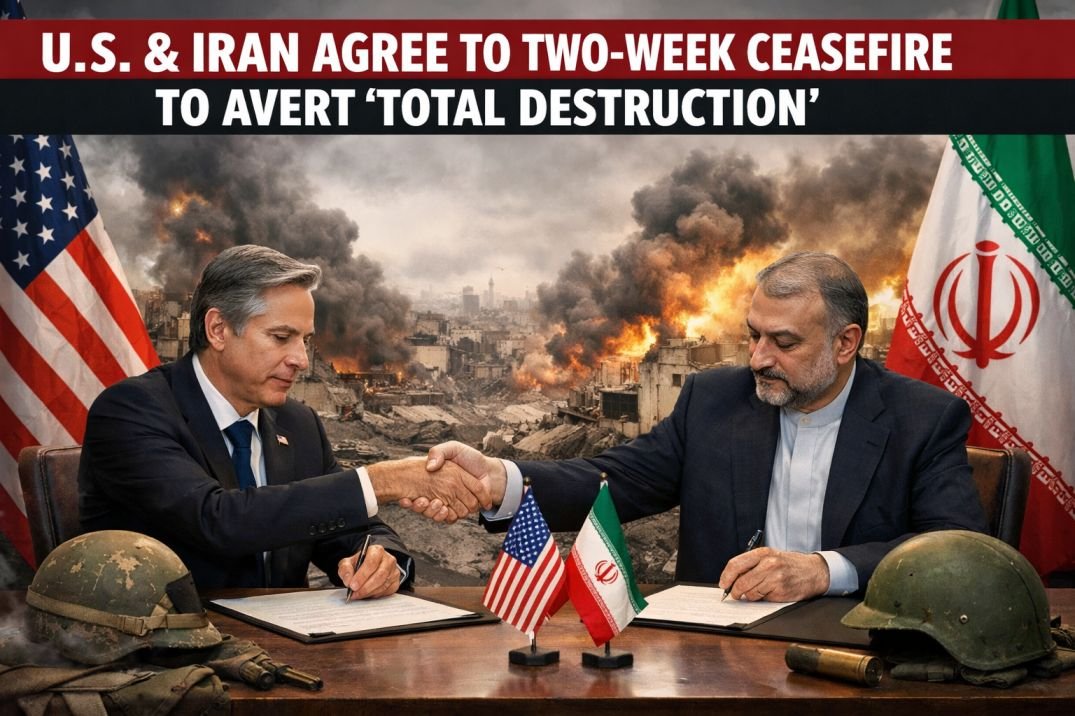
ISLAMABAD — In a dramatic last-minute shift that has momentarily pulled the world back from the brink of a catastrophic regional war, the United States and Iran have agreed to a provisional 14-day ceasefire. The deal, brokered by Pakistani Prime Minister Shehbaz Sharif, went into effect late Tuesday night, just two hours before a deadline set by President Donald Trump to commence large-scale strikes on Iranian civilian infrastructure.
The agreement follows a tense five-week conflict that has seen the assassination of top Iranian officials, hundreds of missile exchanges, and a global energy crisis triggered by the closure of the Strait of Hormuz. President Trump had previously threatened a "complete demolition" of Iran’s bridges and power plants if the waterway was not reopened by 8:00 p.m. ET on April 7.
In a social media post confirming the halt, Trump stated that "subject to the Islamic Republic of Iran agreeing to the COMPLETE, IMMEDIATE, and SAFE OPENING of the Strait of Hormuz," he would suspend all offensive operations. Iran’s Supreme National Security Council countered with its own confirmation, stating it would allow safe passage through the Strait under military management for the duration of the pause.
The "two-week diplomatic push" is built upon a 10-point proposal submitted by Tehran. While the full details remain classified, the framework reportedly includes:
Safe Passage: Reopening the Strait of Hormuz to international shipping, a move expected to stabilize skyrocketing global oil prices.
Hostility Halt: A total cessation of drone and missile strikes between US forces, Israel, and Iranian-backed groups like Hezbollah.
Islamabad Talks: High-level delegations are scheduled to meet in Pakistan on Friday, April 10, to negotiate a permanent armistice.
Despite the optimism, officials on both sides caution that this is not the end of the war. Iranian Foreign Minister Abbas Araghchi clarified that the ceasefire is "conditional" and aimed at "confirming Iran's battlefield achievements." Meanwhile, the White House has emphasized that all military options remain on the table should Tehran violate the terms of the safe passage agreement.
For the residents of Tehran and the wider Middle East, the news brought immediate relief. In the hours leading up to the deadline, "human chains" had formed around Iranian power plants as civilians braced for impact. In Washington, the move is seen as a strategic pivot by the Trump administration to achieve "Longterm PEACE" after achieving initial military objectives.
As the 14-day clock begins, the international community looks to Islamabad. The success or failure of these talks will determine whether 2026 is remembered for a historic diplomatic breakthrough or the start of a much wider, more devastating conflagration.
The Views Express is a news website, we truely believe in presenting & analysing the news that really matters to the people in general.
: +91 9836903612
: theviewsexpress@gmail.com
info@theviewsexpress.in
Mrinmoy Banerjee - Editor In Chief
Moumita Tarafdar - Managing Editor
Supriyo Mukherjee - Associate Editor
Anindya Das - Associate Editor (Honorary)
Copyright © 2024 The Views Express, All Rights Reserved. Developed by PRIGROW