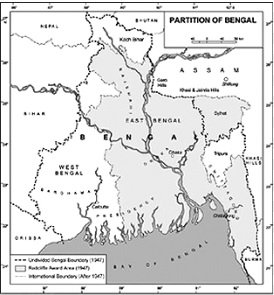
The caption might sound very weird to many but this is historically correct that the region of Bengal was partitioned by India’s colonial masters much before the infamous Partition of Bengal of 1905. When the the district of Sylhet (or Srihatta) was separated from Bengal in 1874 and made a part of the newly created Assam Chief-Commissionership or simply with Assam along with the Bengali speaking areas of Cachar and Goalpara. The rationale for inclusion of Sylhet with Assam, given by the government, as administrative reasons then having tea industry in both Sylhet and in Assam etc. However, the important point is, both the Assamese people of Assam and the Bengali speaking people of Sylhet were not only dissatisfied with the decision but various protests were organised at that point of time. Moreover, after inclusion of Sylhet, that became the most populated district of Assam, causing grief among the Assamese people who just got separated from the Bengal Province and now had its most populated district dominated by a Bengali speaking population. On the other hand, the people of Sylhet were angry with the British government for separating the district from Bengal and making them a part of Assam. So, the partition of Bengal had started in 1874 and showed its full face in 1905, under the stewardship of Governor General Lord Curzon. Very importantly, when Gurudev Rabindranath Tagore visited Sylhet 1919, he not only gave two lectures at Townhall Yard on November 6th and at MC College on November 7th but also wrote a poem on Sylhet in Bengali. The poem was not a simple literary piece by the poet, it stated about cruel exile of Sylhet from Bengal. Moreover, writer and researcher on the works of Tagore, Professor Nripendra Lal Das said, “Rabindranath never wrote any poem about any place except Sylhet”, the English translation of the poem:
“In the cruel stream of time/ you are exiled/ from the frontiers of Bengal/ O land of beauty/ your heart is bound/ with the heart of Bengal/ with the garland of language/ the blessings of Bengal are knotted/ in that bond forever with you.”
Back to 1874, the remaining Bengal with a population of about 8 crores and 1,89,900 sq. miles area continued to be a subject of discussions among the British administrative circles for being a very large area being administered as a single unit and the related issues. Lord Carzon, after his appointment as the Governor General took up the task of portioning Bengal in 1903. His initial plan was about inclusion of the districts of Dhaka (or Ducca), Chittagong and Mymensingh in Assam, as it happened with Sylhet, Cachar and Goalpara. The plan received extreme criticism from all corners of the society. Not only the vernacular newspapers in the region but the English newspapers like Englishmen (considered as the mouthpiece of the conservative English society) also wrote against the move. There were more than 300 protest meetings held only in Eastern Bengal and both the Hindu and Muslim communities together stood against this. Moreover, the principal organisation of the British traders i.e the Bengal Chamber of Commerce also opposed this plan. It did not take much time for Curzon to realise that the political unity among the Bengalis could take the form of a major threat to the very existence of the British Empire in India. Then, Lord Curzon decided to divide the entire Bengal into two parts, one comprising East Bengal, North Bengal and Assam and the other including West Bengal, Odisha (or Orissa) and Bihar. The plan was not only to split up the nationalist, educated and progressive Bengalis but also to reduce them to a minority in both the provinces and also to strengthen the hands of the Bengali Muslims to have them to support the government’s move. In this process, Lord Curzon lent a huge sum of money to the Nawab of Dhaka at a very low interest, tempted him with an enhanced prestige and made him the principal supporter of the partition, which would make East Bengal a separate administrative unit with a Muslim majority.
The plan was designed to weaken the Bengalis who had become very conscious of nationalism. On January 1905, about 300 representatives from different parts of Bengal met in a special conference headed by Sir Henry Cotton, the retired Chief Commissioner of Assam, who presided over the last Indian National Congress session. Where, Sir Cotton proposed about separating Bihar and Chota Nagpur (today’s Jharkhand area) from Bengal, if required for administrative reasons and also to include Sylhet district and Bengali speaking area of Cachar back to Bengal and the resolution was passed in the conference. The conference also urged the government to make a public disclosure of the matter to evaluate the general public opinion in this regard, before implementing the plan. It is important to note that Sir Cotton was not only the President of the Congress but he was also a supporter of Indian Home Rule and during his stay in Assam, he established the Cotton College, at Guwahati (or Gauhati), the oldest institute of higher education in Assam and all of Northeast India.
In the month of May 1905, a memorial with signatures of 60,000 was prepared and despatched to London so that the matter could be stopped and no such decision of partition is approved by the Brtitish government without consulting the people of Bengal. But by then, Mr. Brodrick, the then Secretary of State for India had already approved the proposal by government of India. The government of India made the matter public on July 7th 1905 from Shimla, finally published the decision as a resolution on July 19th and by this, Bengal got partitioned in to two parts. From here the history of colonial India and her freedom movement took a different turn and eminent historian of Dr. R.C Majumdar wrote that the policy of communal discrimination by Lord Curzon gradually came to be accepted as a principal and permanent strategy of British policies and was ultimately responsible for the birth of Pakistan.
Writer: Boddhisatya Tarafdar is a Banker, History Researcher & a Blogger. He usually writes on Indian history & on International Relations
(Note: The OPINION section of The Views Express presents the articles or columns by individuals, where the writer exclusively writes on the matters of History, International Relations, Politics, Economy, Literature etc. on the basis of his or her opinion, knowledge, research & observations on the subject matter)
The Views Express is a news website, we truely believe in presenting & analysing the news that really matters to the people in general.
: +91 9836903612
: theviewsexpress@gmail.com
info@theviewsexpress.in
Mrinmoy Banerjee - Editor In Chief
Moumita Tarafdar - Managing Editor
Supriyo Mukherjee - Associate Editor
Anindya Das - Associate Editor (Honorary)
Copyright © 2024 The Views Express, All Rights Reserved. Developed by PRIGROW


.jpg)